

Health Library
Fanconi syndrome
De Toni-Fanconi-Debré syndrome
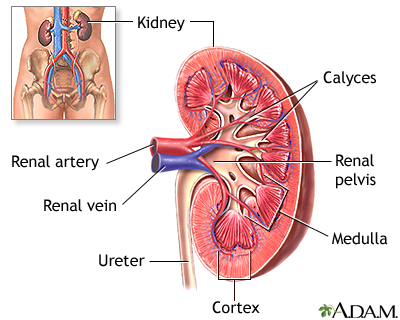
Fanconi syndrome is a disorder of the kidney tubes in which certain substances normally absorbed into the bloodstream by the kidneys are released into the urine instead.
Images
I Would Like to Learn About:
Causes
Fanconi syndrome can be caused by variant genes, or it may result later in life due to kidney damage. Sometimes the cause of Fanconi syndrome is unknown.
Common causes of Fanconi syndrome in children are genetic variations that affect the body's ability to break down certain compounds such as:
- Cystine (cystinosis)
- Fructose (fructose intolerance)
- Galactose (galactosemia)
- Glycogen (glycogen storage disease)
Cystinosis is the most common cause of Fanconi syndrome in children.
Other causes in children include:
- Exposure to heavy metals such as lead, mercury, or cadmium
- Lowe syndrome, a rare genetic disorder of the eyes, brain, and kidneys
- Wilson disease, a genetic disorder resulting in accumulation of excess copper in the body
- Dent disease, a rare genetic disorder of the kidneys
In adults, Fanconi syndrome can be caused by various things that damage the kidneys, including:
- Certain medicines, such as including azathioprine, cidofovir, gentamicin, and tetracycline
- Kidney transplant
- Light chain deposition disease
- Multiple myeloma
- Primary amyloidosis
Symptoms
Symptoms include:
- Passing large amounts of urine, which can lead to dehydration
- Excessive thirst
- Severe bone pain
- Fractures due to bone weakness
- Muscle weakness
Exams and Tests
Lab tests may show that too much of the following substances may be lost in the urine:
- Amino acids
- Bicarbonate
- Glucose
- Magnesium
- Phosphate
- Potassium
- Sodium
- Uric acid
Loss of these substances can lead to a variety of problems. Further tests and a physical exam may show signs of:
- Dehydration due to excess urination
- Growth failure
- Osteomalacia
- Rickets
- Type 2 renal tubular acidosis
Treatment
Many different diseases can cause Fanconi syndrome. The underlying cause and its symptoms should be treated as appropriate.
Outlook (Prognosis)
The prognosis depends on the underlying disease.
When to Contact a Medical Professional
Contact your health care provider if you have dehydration or muscle weakness.
References
Chua AN, Kumar R, Foreman JW. Fanconi syndrome and other proximal tubule disorders. In: Johnson RJ, Floege J, Tonelli M, eds. Comprehensive Clinical Nephrology. 7th ed. Philadelphia, PA: Elsevier; 2024:chap 50.
Kliegman RM, St. Geme JW, Blum NJ, et al. Conditions associated with proteinuria. In: Kliegman RM, St. Geme JW, Blum NJ, et al, eds. Nelson Textbook of Pediatrics. 22nd ed. Philadelphia, PA: Elsevier; 2025:chap 566.
Seifter JL. Acid-base disorders. In: Goldman L, Cooney KA, eds. Goldman-Cecil Medicine. 27th ed. Philadelphia, PA: Elsevier; 2024:chap 104.
BACK TO TOPReview Date: 1/29/2026
Reviewed By: Warren Brenner, MD, Oncologist, Lynn Cancer Institute, Boca Raton, FL. Review provided by VeriMed Healthcare Network. Also reviewed by David C. Dugdale, MD, Medical Director, Brenda Conaway, Editorial Director, and the A.D.A.M. Editorial team.
 | A.D.A.M., Inc. is accredited by URAC, for Health Content Provider (www.urac.org). URAC's accreditation program is an independent audit to verify that A.D.A.M. follows rigorous standards of quality and accountability. A.D.A.M. is among the first to achieve this important distinction for online health information and services. Learn more about A.D.A.M.'s editorial policy, editorial process and privacy policy. A.D.A.M. is also a founding member of Hi-Ethics. This site complies with the HONcode standard for trustworthy health information: verify here. |
The information provided herein should not be used during any medical emergency or for the diagnosis or treatment of any medical condition. A licensed medical professional should be consulted for diagnosis and treatment of any and all medical conditions. Links to other sites are provided for information only -- they do not constitute endorsements of those other sites. No warranty of any kind, either expressed or implied, is made as to the accuracy, reliability, timeliness, or correctness of any translations made by a third-party service of the information provided herein into any other language.
© 1997-
2026 A.D.A.M., a business unit of Ebix, Inc. Any duplication or distribution of the information contained herein is strictly prohibited.
All content on this site including text, images, graphics, audio, video, data, metadata, and compilations is protected by copyright and other intellectual property laws. You may view the content for personal, noncommercial use. Any other use requires prior written consent from Ebix. You may not copy, reproduce, distribute, transmit, display, publish, reverse-engineer, adapt, modify, store beyond ordinary browser caching, index, mine, scrape, or create derivative works from this content. You may not use automated tools to access or extract content, including to create embeddings, vectors, datasets, or indexes for retrieval systems. Use of any content for training, fine-tuning, calibrating, testing, evaluating, or improving AI systems of any kind is prohibited without express written consent. This includes large language models, machine learning models, neural networks, generative systems, retrieval-augmented systems, and any software that ingests content to produce outputs. Any unauthorized use of the content including AI-related use is a violation of our rights and may result in legal action, damages, and statutory penalties to the fullest extent permitted by law. Ebix reserves the right to enforce its rights through legal, technological, and contractual measures.
